5 Tips Every IMG Should Know Before Submitting Their ERAS Application
Dr. Karmali shares practical advice for international medical graduates (IMGs) preparing for residency applications.
For many international medical graduates, opening the ERAS application marks the beginning of one of the most important—and often overwhelming—milestones on the journey to U.S. residency.
Between personal statements, letters of recommendation, transcripts, and application deadlines, there are countless details to manage. It's easy to become so focused on completing each section that you lose sight of the bigger picture: presenting the strongest possible version of yourself.
To help students prepare, we sat down with Dr. Adam Karmali, Chief Medical Officer and Co-Founder of RotationSync, to discuss the five most important things every IMG should keep in mind before submitting an ERAS application.
1. Know Your Timeline Before You Begin
One of the biggest mistakes you can make isn't submitting a weak application—it's running out of time. Between requesting transcripts, securing letters of recommendation, refining your personal statement, and completing every section of the application, there are many moving pieces that require careful planning. It's also important to understand that the ERAS season and residency application timeline are not the same. For example, the 2027 ERAS season opened on June 4, 2026, but residency programs will not be able to view applications until September 23, 2026. In addition, each residency program establishes its own application deadlines, so it's essential to research every program on your list and submit your application accordingly. The earlier you begin preparing, the more time you'll have to strengthen your application and avoid unnecessary stress. For the most up-to-date dates and deadlines, visit the official ERAS website, and be sure to review our 2027 ERAS Residency Timeline for a month-by-month planning guide.
2. Every Word Matters
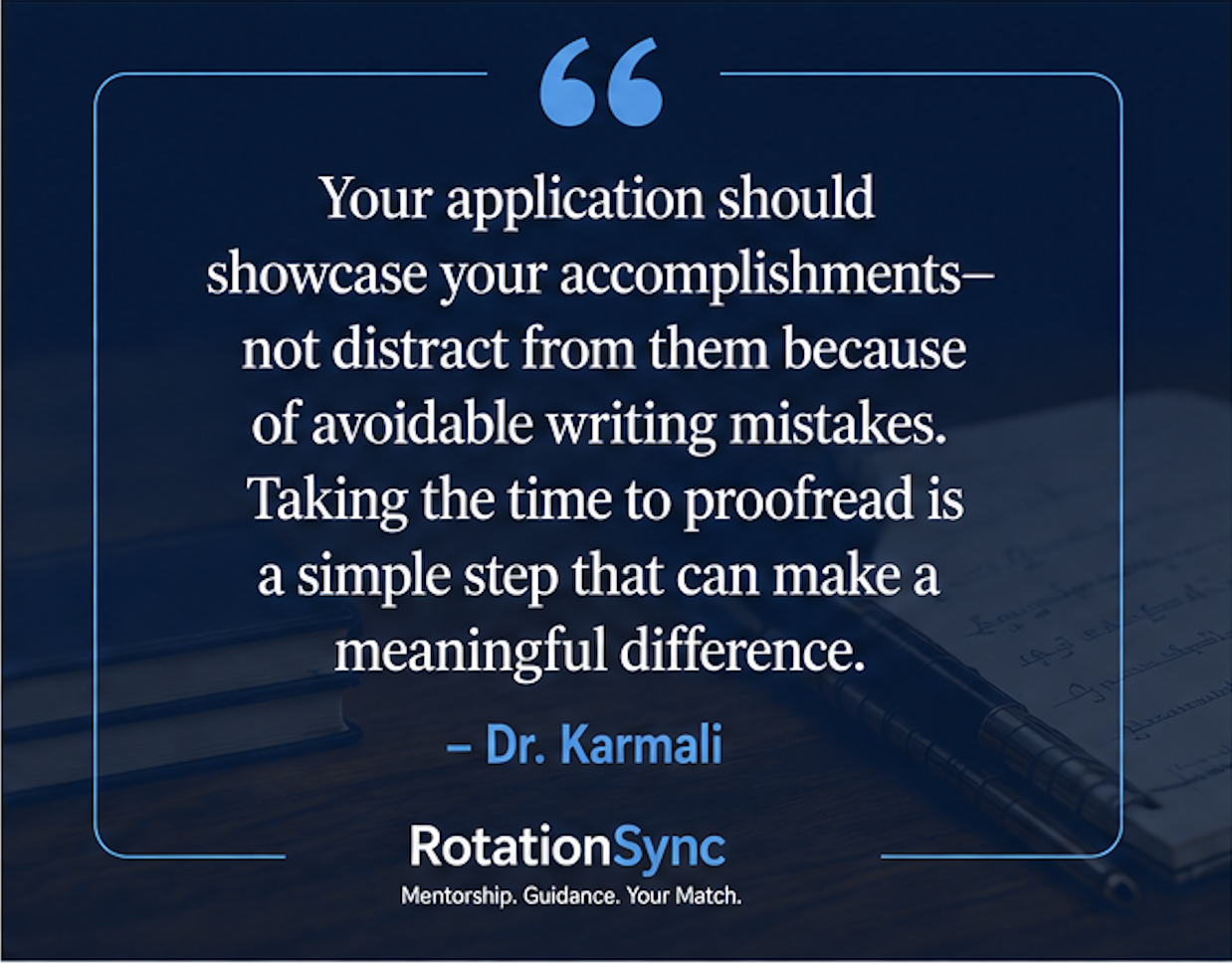
For many international medical graduates (IMGs), English is not your first language, making it especially important to take extra time when completing every written component of your application. Your personal statement, ERAS responses, and other written materials should communicate your experiences clearly, professionally, and confidently. Small grammatical or spelling mistakes—such as confusing there, their, and they're—may seem minor, but they can distract reviewers and unintentionally take attention away from the strengths of your application. Before submitting, carefully proofread your work for grammar, syntax, spelling, and clarity. Even better, ask a trusted mentor or colleague to review your application with fresh eyes. Your goal is to ensure that your writing reflects the same professionalism, attention to detail, and communication skills that you will bring to residency.
3. Strong Letters of Recommendation Can Make a Difference
Your letters of recommendation are more than just another application requirement—they provide residency programs with valuable insight into the kind of physician and colleague you'll be. Strong letters offer specific examples of your clinical knowledge, work ethic, professionalism, communication skills, and ability to function as part of a healthcare team.
As you begin requesting letters, consider both the quality of the letter and who is writing it. While some specialties utilize a Standardized Letter of Evaluation (SLOE), applicants pursuing Internal Medicine are generally better served by strong Narrative Letters of Recommendation that provide personalized observations about their clinical performance and potential as a future resident.
Another common question is, "How many letters should I submit?" In most cases, three strong letters of recommendation are appropriate, while four carefully selected letters can strengthen your application even further.
For applicants pursuing Internal Medicine, Dr. Karmali recommends building a well-rounded collection of letters whenever possible. Ideally, your letters should reflect different aspects of your clinical training and may include:
An inpatient Internal Medicine hospitalist
An outpatient Internal Medicine physician
An Internal Medicine subspecialist, such as Cardiology, Nephrology, Gastroenterology, Hematology/Oncology, Endocrinology, Rheumatology, or Infectious Disease
If you choose to submit a fourth letter, make sure it genuinely adds value to your application. Rather than submitting another letter simply to increase the total number, ask yourself whether it provides a new perspective on your abilities or highlights an experience that isn't already represented elsewhere in your application. A compelling fourth letter should strengthen your overall story—not simply add another name to your file. It’s important to note that some academic programs require a department chair letter of recommendation, which will fill this fourth slot.
Remember the strongest letters aren't necessarily written by the most well-known physicians—they're written by physicians who know you well and can speak specifically about your growth, clinical judgment, professionalism, and potential as a future resident. That being said, if you have multiple potential options, letters from academic attendings often carry more weight especially if applying to their current program or alma mater.
4. Be Intentional About Your Strategy and Your Calendar
One of the most common mistakes applicants make is waiting until the ERAS application opens to begin preparing. In reality, a competitive application is built over months—not weeks. The strongest applicants understand the residency timeline well in advance and work backward from key deadlines to ensure every component of their application is completed on time.
Start by familiarizing yourself with the ERAS timeline and the application deadlines for each residency program you're considering. Keep in mind that every program establishes its own deadlines, so don't assume they are all the same. If you're planning to complete U.S. clinical rotations, schedule them early enough to allow your supervising physicians adequate time to evaluate your performance and write thoughtful letters of recommendation. Strong letters are rarely written overnight, so be respectful of your preceptors' time and request them well in advance.
This is also the time to think strategically about the rest of your application. Have you completed the clinical experiences you want residency programs to see? Is your personal statement drafted with enough time for multiple revisions? Have you identified the physicians you hope will write your letters? Are your transcripts, examination scores, and supporting documents ready to upload?
By creating a realistic timeline and planning ahead, you'll avoid unnecessary stress, submit a stronger application, and give yourself the flexibility to focus on presenting your best work rather than racing to meet deadlines.
The best time to prepare your ERAS application isn't when the application opens—it's months before. Planning ahead gives you the opportunity to strengthen every aspect of your application instead of simply completing it.
5. Submit with Confidence—Then Prepare for What's Next
Submitting your ERAS application is a significant milestone, and it's one worth celebrating. After months of preparing for exams, completing clinical rotations, requesting letters of recommendation, refining your personal statement, and carefully assembling every piece of your application, you've reached an important moment in your residency journey. Take a deep breath and allow yourself to celebrate your accomplishment. Whether it's spending time with family and friends, enjoying a nice dinner, or taking a weekend getaway you've been putting off, give yourself permission to pause and recognize how far you've come.
Once you've had a chance to recharge, it's time to shift your focus to the next stage of the Match process: residency interviews. Interview invitations can begin arriving sooner than many applicants expect, so don't wait until your first invitation appears in your inbox to start preparing. Practice answering common interview questions with trusted mentors, colleagues, or friends, and take time to reflect on the experiences that have shaped your journey. Be prepared to discuss your clinical experiences, your motivation for pursuing your chosen specialty, and the unique perspective you bring as an international medical graduate.
Finally, remember that residency interviews may be conducted in a variety of formats, including virtual, hybrid, and in-person interviews. Practicing in different settings will help you feel more comfortable and confident regardless of the format. The work you've invested in preparing your application has brought you to this point—now it's time to prepare to tell your story.
Submitting your application isn't the finish line—it's the beginning of the next chapter of your residency journey. Prepare with the same intention and dedication that brought you this far.